
10 Best Screen-Free Activities for Babies
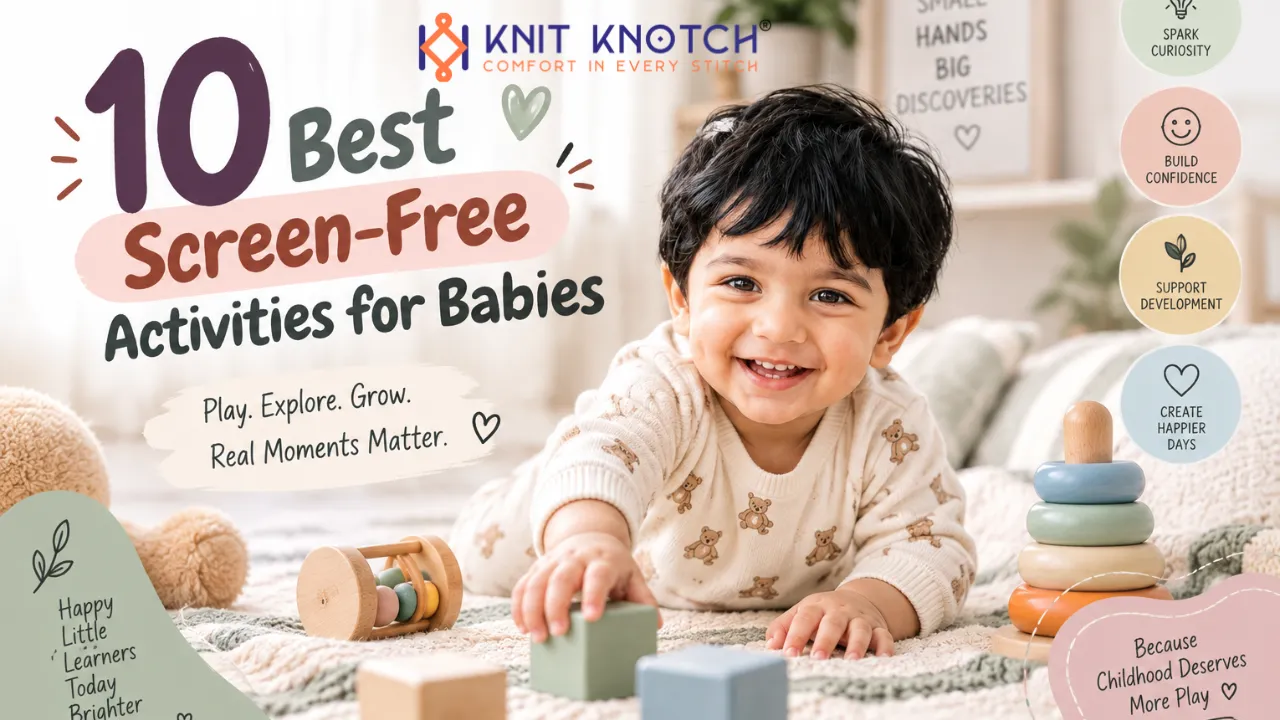
Easy, low-prep ideas to replace phone time with talking, movement, sensory exploration and meaningful parent-baby play.
10 Best Screen-Free Activities for Babies
Babies do not need complicated toys or elaborate setups to stay engaged. Your face, voice, a safe floor space, a book and a few simple objects can create plenty of opportunities to explore, move and connect.
The World Health Organization recommends no sedentary screen time for infants under 1 and for 1-year-olds, while encouraging interactive floor-based play, reading and storytelling. The American Academy of Pediatrics also emphasizes that infants learn best through real-world interaction with caregivers. ?cite?turn0search0? ?cite?turn0search7?
01Tummy Time + Reach & Grab
Place your awake baby on a clean, comfortable floor mat and position one safe toy slightly in front or to the side. Encourage them to look, reach, turn or eventually roll toward it.
Why try it: It combines screen-free entertainment with active floor play. WHO recommends that non-mobile infants get at least 30 minutes of tummy time spread across the day while awake. ?cite?turn0search0?
Try with: a soft rattle, high-contrast card or baby-safe toy.
02Peekaboo With Mum or Dad
Cover your face with your hands or a light cloth, then reappear with a smile. Keep it slow and let your baby react before repeating.
Why babies love it: It is simple, social and full of facial interaction. The AAP highlights games such as peekaboo as useful face-to-face, turn-taking play. ?cite?turn0search12?
03Picture-Book Time
You do not need to finish the story. Point at a dog, ball, tree or baby in the book, name it and let your child touch or look at the pictures.
Make it interactive: “Where's the dog?” “Look at the red ball!” “Can you see the baby?” CDC encourages parents to look at colorful pictures, name what babies see and respond to their babbling. ?cite?turn0search2?
04Sing, Clap & Move
Sing a familiar rhyme while clapping, gently bouncing, waving or moving your hands. Your voice is already one of your baby's most interesting “toys.”
CDC recommends talking, reading and singing with babies, while the AAP notes that singing and gentle movement can be useful activities from the earliest months. ?cite?turn0search10? ?cite?turn0search4?
05Baby-Safe Sensory Basket
Create a tiny basket of a few large, safe objects with different textures—for example, a soft cloth, silicone teether and textured baby ball. Let your baby touch and explore one item at a time.
Safety first: Everything must be age-appropriate, clean, non-toxic and too large to become a choking hazard. CDC notes that babies learn by safely seeing, hearing, touching and mouthing objects. ?cite?turn0search5?
06Mirror Faces
Sit with your baby in front of a securely positioned, baby-safe unbreakable mirror. Smile, stick out your tongue, point to your nose and describe what you see.
Keep the activity conversational: “That's your nose,” “Mama is smiling,” or “Look at those eyes!” It turns a simple reflection into face-to-face language play.
07Roll the Ball
For babies who can sit with appropriate support or independently, slowly roll a soft ball toward them. Older babies can push or roll it back.
Make it playful: say “My turn… your turn!” CDC specifically suggests passing a toy back and forth as a simple turn-taking game around 9 months. ?cite?turn0search13?
08Texture & Fabric Exploration
Let your baby feel a few clean fabrics with noticeably different textures—such as smooth cotton, soft muslin and a textured towel—while you describe each sensation.
Say simple words such as “soft,” “smooth” and “bumpy.” Avoid loose threads, buttons, beads, cords or anything that could detach.
09Outdoor Discovery Walk
Take your baby outside in an age-appropriate stroller or carrier and turn the walk into a conversation. Point out trees, birds, cars, flowers, clouds and everyday sounds.
The AAP suggests walks as a way to show babies new things, while CDC recommends pointing out and naming objects such as cars, trees and animals. ?cite?turn0search4? ?cite?turn0search2?
10Copy My Sound
When your baby babbles—“ba,” “ma,” “da”—copy the sound, smile and wait. When they respond, answer again. You have just turned babbling into a tiny conversation.
CDC recommends responding positively to babies' sounds, repeating them and adding words to encourage back-and-forth communication. ?cite?turn0search5?
Screen-Free Activities by Baby's Stage
| Stage | Simple ideas | Keep in mind |
|---|---|---|
| 0–3 months | Face-to-face talking, singing, cuddling, supervised tummy time | Keep sessions short and follow baby's cues |
| 3–6 months | Reaching games, picture books, rattles, mirror play | Use large, baby-safe objects |
| 6–9 months | Peekaboo, rolling/reaching, texture play, songs | Expect mouthing and supervise closely |
| 9–12 months | Turn-taking, ball rolling, books, outdoor discovery | Give safe space for increasing mobility |
How to Make Screen-Free Play Easier
- Keep 3–5 safe play items accessible rather than offering everything at once.
- Rotate familiar toys instead of constantly buying new ones.
- Talk through ordinary routines such as dressing, folding clothes or going for a walk.
- Use the floor whenever appropriate so babies have room to move.
- Choose comfortable clothing that allows easy kicking, crawling, rolling and reaching.
- Put your own phone away for a few minutes and make eye contact during play.
FAQs
What are the best screen-free activities for babies?
Tummy time, peekaboo, books, singing, reaching games, safe sensory exploration, mirror play, outdoor walks and simple turn-taking are easy options requiring little preparation.
How can I entertain my baby without a phone?
Start with interaction rather than entertainment: talk, copy their sounds, sing, read, make faces, place safe toys within reach or take a short outdoor discovery walk.
What can I do with a 6-month-old without screens?
Try supervised tummy/floor play, reaching for toys, picture books, songs, peekaboo, mirror faces and safe textures. CDC specifically encourages books, singing and placing toys slightly out of reach to encourage movement. ?cite?turn0search2?
Do babies need special educational toys?
Not necessarily. Everyday interaction is valuable: talking, singing, reading and playing with simple age-appropriate objects can provide rich opportunities for learning and connection.
Less scrolling. More little moments.
Screen-free play doesn't have to be complicated. Give babies comfortable clothes, a safe place to move and something even better than a screen—your attention.
Explore Comfortable Kidswear ?